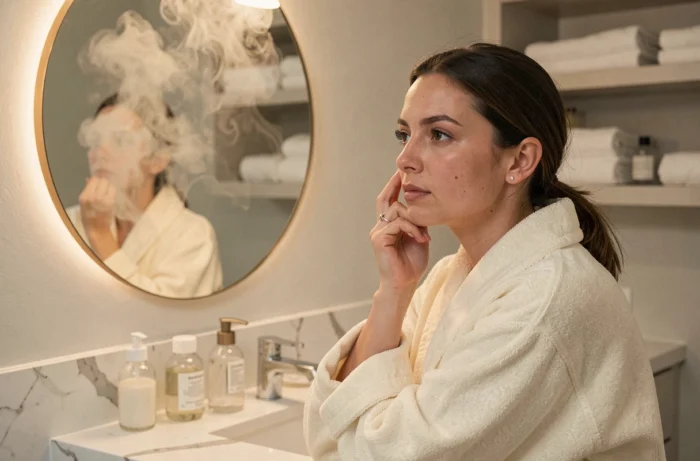
The European cosmetics market is undergoing a phase of accelerated reformulation. New restrictions published in 2026 target twelve substances in cosmetic products, based on concerns related to endocrine disruption or genotoxicity. Among them, triphenyl phosphate will be banned starting January 2027, and the allowed concentrations of benzyl salicylate are further tightened.
These changes affect categories of products used every day: perfumes, sunscreens, moisturizing care. The daily beauty routine is no longer just a sequence of gestures; it also depends on what the bottles actually contain.
Beauty routine and cosmetic regulation: what changes concretely in 2026
The latest European restrictions modify the annexes of the current cosmetic regulatory framework. In practice, several common ingredients in facial care and sunscreen products are affected.
Homosalate, a UV filter present in many sunscreens and makeup bases with SPF, sees its maximum allowed concentration reduced. For consumers, this means that some current sunscreen products will need to be reformulated before their next market release.
Checking the INCI list of your usual care products becomes a relevant reflex, especially if you have been using the same references for several years. Brands that included substances now restricted in their formulations will need to offer alternatives.
Field feedback varies on this point: some brands have anticipated these restrictions, while others still market formulas that will have to change. On Mon Blog Beauté, ongoing reformulations are regularly tracked to help identify affected products.
Skin barrier approach: rethinking the order of facial care
The most visible content on beauty routines remains centered around a classic scheme: cleanse, exfoliate, hydrate, protect. This sequence is not incorrect, but it overlooks a structural evolution that has emerged in recent years in the formulation of care products.
The so-called “barrier-first” approach places the preservation of the skin barrier before the accumulation of active ingredients. The reasoning is simple: skin with a compromised barrier function absorbs actives poorly and reacts excessively to external aggressions. Multiplying concentrated serums on a weakened barrier often produces the opposite of the desired effect.
Adapting care to the skin’s seasonal cycle
Sebum production, natural hydration levels, and sensitivity to UV vary by season. An identical routine in January and July does not take these physiological variations into account.
- In cold periods, the skin barrier endures temperature fluctuations between heated indoors and the outdoors. Neutral pH cleansers and textures rich in ceramides or fatty acids limit transepidermal water loss.
- In warm periods, sebum production increases. Lightweight textures, alcohol-free mists, and sunscreen adapted to the new restrictions (reformulated filters) take over.
- During transitional seasons, the skin goes through an adaptation phase where temporarily reducing the number of active products helps avoid irritation reactions.
This seasonal logic, documented in technical publications on routines compliant with European cosmetic regulations, remains absent from most mainstream beauty guides.
Makeup and eye care: the gestures that change the result
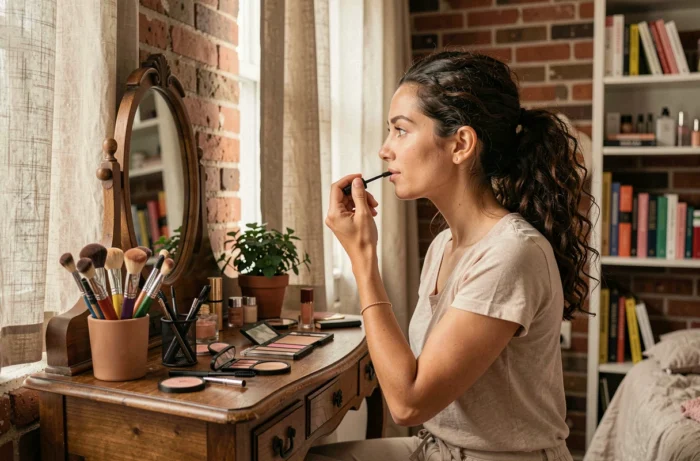
The eye contour area concentrates the most visible signs of fatigue and dehydration. The skin here is significantly thinner than on the rest of the face, making it more reactive to irritating actives and repeated mechanical gestures.
Applying an eye contour treatment before foundation improves makeup longevity in this area and limits the dehydrating effect associated with pigments. The gesture is as important as the product: tapping with the fingertip of the ring finger (the finger that exerts the least pressure) rather than rubbing.
Choosing makeup products with the INCI list
The regulatory restrictions of 2026 also affect components found in certain foundations and powders.
Reading the composition does not require a chemistry degree. Spotting the first five or six ingredients on the INCI list already provides a reliable indication of the product’s base. The first three ingredients represent the majority of the formula. If a UV filter or a controversial preservative appears in this trio, the product deserves to be reevaluated.

Hair and accessories: the overlooked angles of the beauty routine
The beauty routine does not stop at the face. Hair suffers from the same environmental aggressions (UV, pollution, hard water) and benefits from the same preservation logic of the barrier.
Spacing out shampoos and favoring formulas without harsh sulfates reduces the stripping of the scalp’s hydrolipidic film. The available data do not allow for a universal frequency, as hair type and lifestyle play a determining role.
Accessories also matter. A hair tie that is too tight causes mechanical breakage, while a pillow made of synthetic fibers increases nighttime friction. These seemingly anecdotal details produce visible cumulative effects over several months.
- Spaced pin brushes detangle without pulling hair when wet (more fragile than dry).
- Clips without exposed metal avoid micro-lesions on the hair shaft.
- Pillowcases made of smooth fibers (satin or silk) reduce friction and preserve the hair’s natural smoothness.
Building a sustainable beauty routine rather than a trendy one
Social media renew skincare trends at a pace that does not correspond to the skin’s cellular renewal cycle, estimated at several weeks. Changing serums every two weeks prevents proper evaluation of a product’s effect.
A stable routine for at least four to six weeks yields more readable results than a succession of tests. The minimalism claimed by some trends (three products maximum) is not a dogma, but it raises a useful question: does each product in your routine have a distinct and measurable role on your skin?
The reformulations imposed by the new European restrictions paradoxically offer an opportunity: to reevaluate your usual products, check their compliance, and refocus your routine on care whose composition is transparent and effects documented.