
A radiator that no longer heats on a Monday morning in January, a puddle under the boiler discovered upon returning from work: in Brussels, these situations are rarely resolved with a single phone call if you don’t know where to look or what to check before the technician arrives. Understanding the nature of the heating failure or leak can save time, limit damage, and sometimes avoid unnecessary intervention.
Diagnosis before calling: what can be checked without a heating technician in Brussels
Before picking up the phone, several common causes can be eliminated. A boiler displaying an error code has often switched to safety mode after a brief power cut or a drop in pressure in the circuit.
The pressure gauge, located on the front of the boiler, indicates the water circuit pressure. If the needle has fallen below the green zone (usually below 1 bar), a simple refill via the filling valve may be enough to restart the device. Open it slowly, wait for the needle to rise into the normal range, then close it.
If the pressure drops again within a few hours, it is a sign of a leak in the heating circuit, whether visible (puddle, moisture trace on a fitting) or hidden (in a slab, behind a partition). In this case, turning off the water supply to the boiler and placing a container under the leak point limits damage while waiting for repairs.
To deepen the reflexes to adopt in the face of such an emergency, you can consult Le Comptoir Web in Brussels, which details the concrete steps according to the type of failure.
Heating leak in Brussels: locating the problem in the circuit
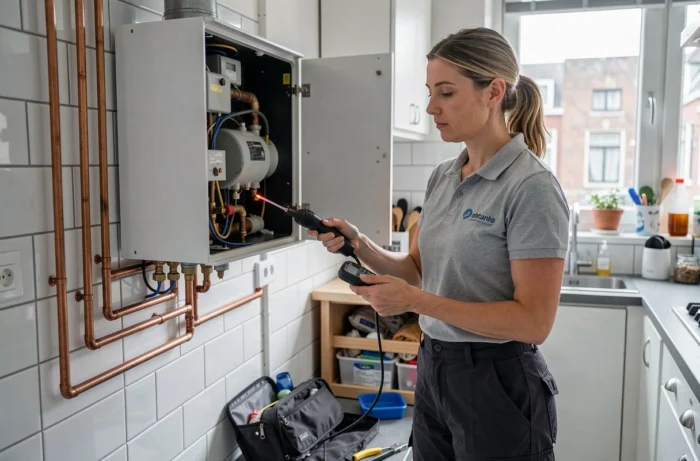
Not all leaks are the same. A seepage at a radiator fitting can be addressed by tightening a nut or changing a seal. A leak on a pipe embedded in a screed requires a leak detection using thermal imaging or tracer gas, a more specialized service.
Classic weak points in a heating circuit
- Screwed connections and thermostatic valves of radiators, where seals age with repeated heating cycles
- The expansion vessel, whose internal membrane can puncture after several years, causing a pressure rise and then a discharge through the safety valve
- Bends and welds on old copper installations, particularly in pre-war Brussels buildings where the piping has not been replaced for decades
- The heat exchanger itself, especially in older floor-standing boilers where corrosion attacks the exchanger
When the leak comes from the boiler itself (punctured exchanger, defective flange seal), repairing is not always cost-effective on a device older than fifteen years. The technician will raise the question of replacement, and this is where Brussels regulations come into play.
Heating regulations in Brussels: what changes for boiler replacements
A serious failure requiring a complete replacement is no longer managed as it was five years ago. Since June 1, 2025, the installation of an oil boiler is prohibited in the Brussels-Capital Region, including as a replacement for an existing device, unless a specific exemption is granted.
For natural gas, the situation is also evolving. Since January 1, 2025, gas is prohibited in projects where all units are new or considered new. Starting January 1, 2030, this ban will extend to major renovations.
In practical terms, if your gas boiler breaks down and the repair is too expensive, you can still replace it with a condensing gas boiler in most cases of classic renovation. Feedback varies on this point depending on municipalities and building configurations, but the direction is clear: Brussels is pushing towards heat pumps as a medium-term replacement solution.
Mandatory maintenance and its link to failures
The PEB regulation requires a periodic check every two years for gas boilers and water heaters, and annually for oil installations. The certified PEB technician checks combustion, tightness, and overall condition.
Many failures and leaks are detected during these inspections, not before. Skipping maintenance often delays the discovery of a worsening problem. Administrative fines for non-compliance with this obligation range from 125 to 25,000 euros in Brussels.
Emergency heating repair: choosing the right service provider in Brussels
The Brussels heating repair market is dense, and prices vary significantly from one provider to another, especially for emergency interventions (evenings, weekends, holidays).
Here are some concrete criteria to filter:
- The G1 or G2 certification of the technician, mandatory for working on gas installations in Brussels. A technician without this certification cannot legally touch your gas boiler
- Price transparency: a quote or at least an hourly rate announced before the visit, including travel costs. Night and weekend surcharges must be specified
- Availability of common spare parts (three-way valves, circulators, exchangers for widespread brands like Vaillant, Bulex, or Viessmann), which avoids a second visit and thus double billing
A certified technician who announces their rate before traveling remains the best filter against unpleasant surprises. You can also verify the certification on the Brussels Environment website.
Tenant or owner: who pays for heating repairs in Brussels
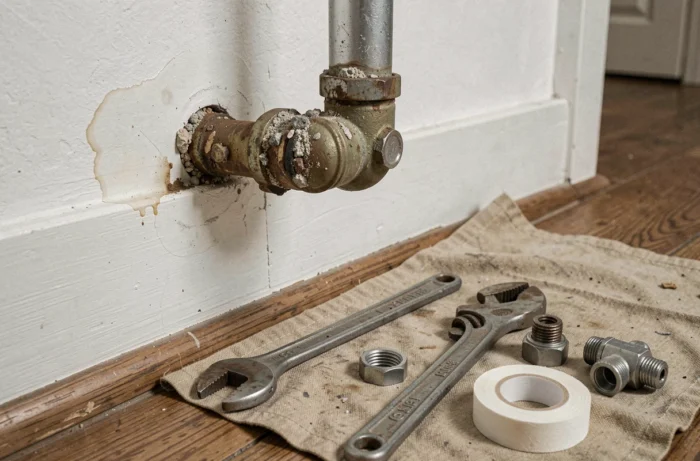
This question arises with every breakdown. Under Belgian law, the basic rule distinguishes between routine maintenance (the tenant’s responsibility) and major repairs related to wear or a defect in the installation (the owner’s responsibility).
The mandatory periodic maintenance of the boiler is the tenant’s responsibility, unless otherwise stated in the lease. On the other hand, the replacement of an end-of-life boiler falls under the owner’s responsibility. A leak caused by the corrosion of an exchanger after twenty years of use cannot be charged to the tenant.
The gray area concerns minor repairs on wear parts (seal, bleeder, thermostatic valve). In practice, these costs often remain the tenant’s responsibility, but a well-drafted lease clarifies this distribution from the outset.
In the face of a leak or heating failure in Brussels, the most cost-effective reflex remains methodical checking before the call, followed by choosing a certified technician who provides a transparent diagnosis. With ongoing regulatory changes regarding gas and oil, each repair intervention also becomes an opportunity to reassess the relevance of the existing installation.