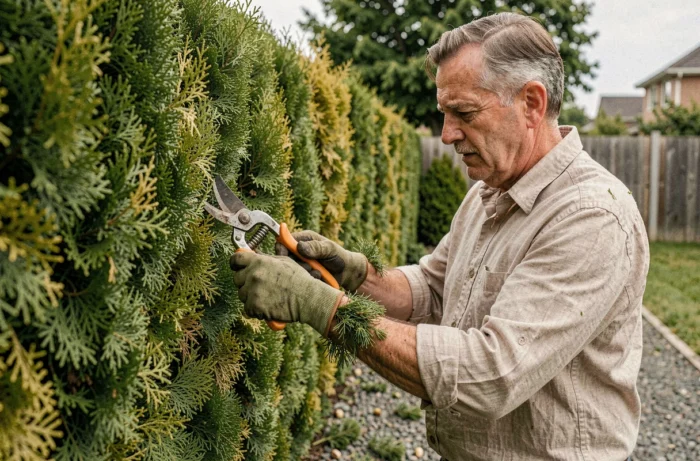
A thuja left untrimmed for two seasons can easily grow about twenty centimeters in width and height. You quickly end up with a hedge that overflows onto the sidewalk or into the neighbor’s yard. The problem is that thuja does not forgive a cut that is too deep. Choosing the right time and method makes all the difference between a dense hedge that lasts for decades and a permanent brown curtain.
Old wood of thuja: the limit never to cross
Competitors talk about tools, schedules, legal height. Before all that, there is a technical point that many gardeners discover too late: thuja does not regrow on bare brown wood. Unlike yew, it does not have latent buds capable of restarting growth on an old branch.
In practical terms, if you cut beyond the green zone and expose the bare wood, the affected side will remain brown. Neither fertilizer, watering, nor time will change anything. The only option then becomes replacing the plant or camouflaging it with a climbing plant.
To avoid this, always keep a thickness of green foliage on each side. For a hedge that has become too voluminous, it is better to spread the correction over two or three years, removing a few centimeters at a time, rather than trying to fix everything at once. When looking to trim a thuja or cut thuja without risk, this rule about brown wood is the first reflex to adopt.
Thuja trimming schedule: two windows to respect
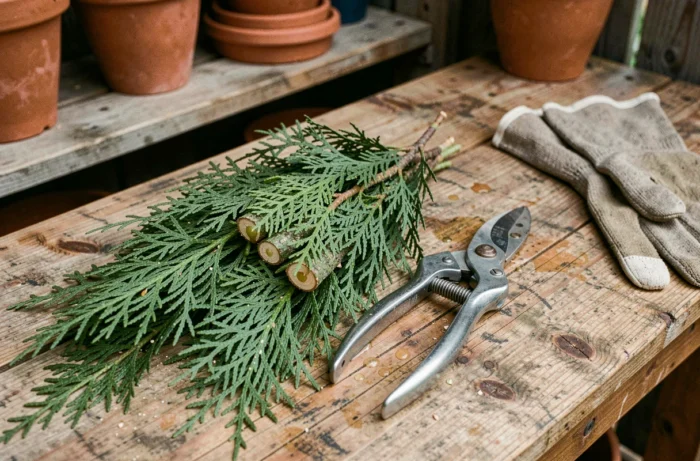
It is often said that trimming should be done “in spring” or “in autumn,” without further precision. In practice, the two most favorable time slots are May and the period from August 15 to September 15. These windows correspond to phases of active growth where healing is quick and foliage regrows rapidly.
Why these two dates and not others
In May, the first sap flow begins. New shoots quickly cover the cuts, limiting the yellowed appearance post-trim. Between mid-August and mid-September, the second wave of growth allows for the same effect. Outside of these windows, the hedge heals more slowly and remains marked for a longer time.
You can also intervene occasionally in June or July for a light refresh, but significant cuts should be reserved for the two main periods.
Trim in overcast weather, not in full sun
A detail that changes the visual result: it is preferable to trim under an overcast sky or at the end of the day. Wounds exposed to direct sunlight dry out abruptly, causing the characteristic yellowing on the trimmed sides. A cloudy day reduces water stress and gives the branches time to close without burning.
Nesting and regulations: what we really risk
The OFB recommends avoiding trimming hedges from March 15 to July 31, the nesting period. For individuals, there is no general national prohibition based on a single date. However, the intentional destruction of nests or eggs of protected species remains prohibited year-round.
Some departments have stricter prefectural orders. In Alsace, for example, local rules may further restrict the allowed periods. Checking the prefectural orders in your department before taking out the hedge trimmer is not a formality: fines do exist.
In practice, if you spot an active nest in the hedge, postpone the trimming, regardless of the month. The right reflex is to take a tour of the hedge in the days leading up to it and observe the comings and goings of birds.
Hedge height and property lines: the thresholds to know
Trimming thuja is not just a matter of timing. Legal height also comes into play, and this is often the source of conflicts between neighbors.
- A planting located less than 50 cm from the property line must not exceed 2 m in height, unless local rules differ.
- Beyond 2 m from the fence, height is no longer limited by the Civil Code, but municipal planning regulations may apply.
- The neighbor can demand compliance if the hedge exceeds the thresholds, with no statute of limitations on the request for pruning.
Measuring the height from the ground on the lowest side is the method used in case of disputes. On sloped land, the difference in level can be surprising.
Cutting technique: maintain a trapezoidal profile
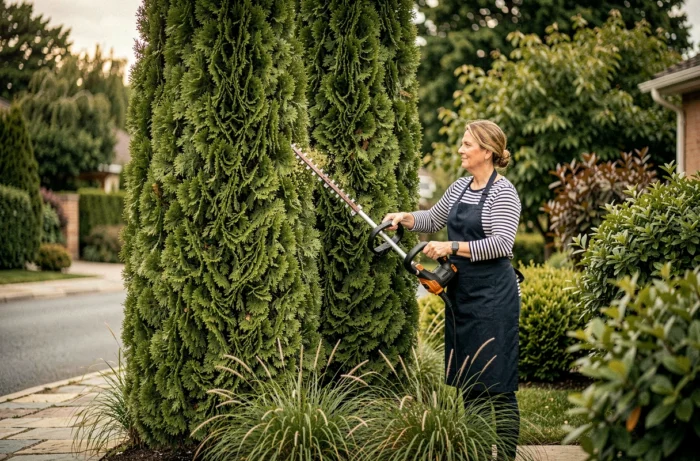
Trimming a thuja straight up seems logical, but the base of the hedge ends up thinning due to lack of light. The ideal profile is slightly trapezoidal: wider at the bottom, narrower at the top. This shape ensures that sunlight reaches the lower branches.
Start with the sides, from bottom to top, moving the hedge trimmer blade up along the surface. The top is trimmed last, either flat or very slightly rounded. For hedges longer than two meters, stretching a line helps maintain a straight line without having to step back constantly.
- Clean and sharp blade for clean cuts (dirty blades crush foliage and promote diseases).
- Remove dead or dry branches before using the hedge trimmer, to see the true silhouette.
- Do not trim more than one-third of the green volume in a single intervention, especially on an older subject.
Spreading the correction over several annual passes protects the hedge and avoids exposing bare wood. The feedback varies on the recolonization time, but two to three seasons are generally enough to regain a proper volume after moderate excess growth.
Managing a thuja hedge ultimately rests on a simple principle: cut little but regularly. Two interventions per year at the right times, keeping an eye on the remaining green foliage, and checking local rules are enough to maintain a dense green screen without unpleasant surprises.