Parking two cars side by side is one thing. Being able to leave headfirst without maneuvering for three minutes in a tight space is another. The size of a car turning area affects both daily usability and the compliance of your project with local urban planning regulations. Before pouring any concrete, it’s better to understand what really determines the size of this space.
Turning radius and vehicle size: the starting point for sizing
Competitors often talk about fixed dimensions, as if all vehicles maneuver the same way. In reality, the size of your area primarily depends on the turning radius of the largest vehicle that will use it.
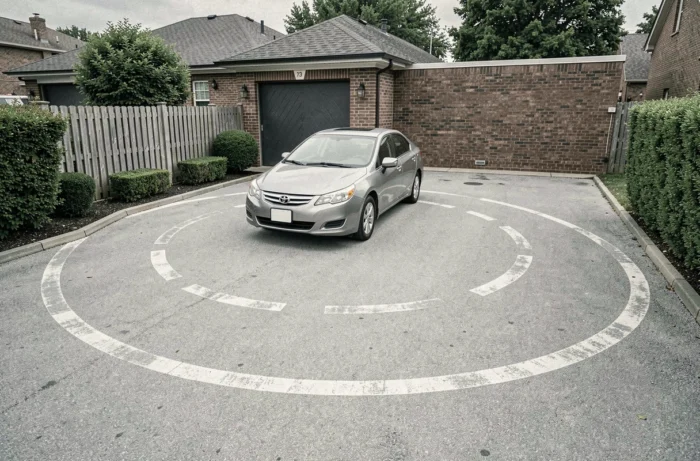
The turning radius is the distance between the center of the circle described by the vehicle while turning and the outer wheel. A city car turns in a much tighter circle than an SUV or a van. If you size your area for a small car, a wider or longer vehicle simply won’t be able to turn around without encroaching on a flowerbed or a wall.
The width of cars has significantly increased in recent years. Recent professional recommendations now suggest 2.50 m of width per vehicle for parking spaces, compared to 2.30 m in the old NF P91-100 and NF P91-120 standards. This detail changes the total area required, especially when the turning area is adjacent to the parking.
To properly choose the required dimension for a car turning area, always start with the largest vehicle you own or might acquire. Allowing for some margin avoids having to redo everything in a few years.
T, Y, or semicircle turning area: which shape for which terrain
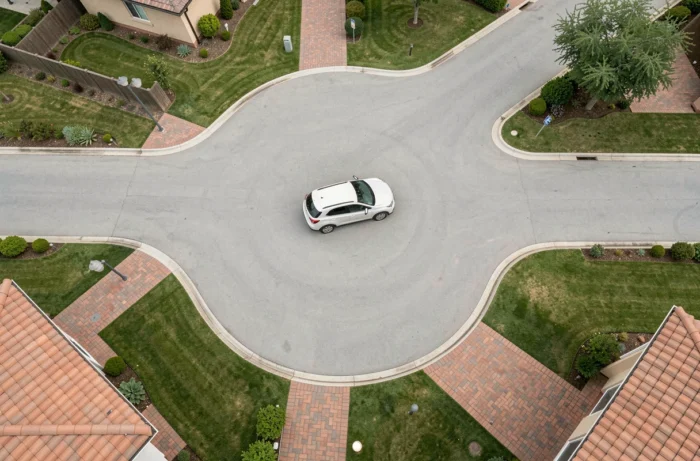
Do you have a wide and clear piece of land? A semicircle is the most comfortable solution. The vehicle turns continuously, without reversing. However, this shape requires a generous free space.
On a narrow or elongated piece of land, two other configurations prove to be more suitable.
T turn
The driver moves forward into a perpendicular branch, reverses, then drives forward in the opposite direction. This maneuver requires three movements. The advantage: a T turn fits into a more compact space than a semicircle. You need to plan for a lateral branch at least 3 m wide and sufficient depth so that the front of the vehicle does not hit an obstacle.
Y turn
Similar to the T, but with a different angle. The Y allows for managing an access at an angle to the road. It’s a useful variant when the terrain configuration does not allow for a sharp right angle. The dimensions remain comparable, with a circulation lane of at least 5 m wide for comfortable maneuvering.
In both cases, the basic rule remains the same: the vehicle must be able to turn around in a maximum of three maneuvers, without risking hitting a wall, a fence, or another parked vehicle.
Constraints related to emergency vehicles and urban planning rules
You are arranging your land for your own cars, but that’s not the only criterion. At the end of a cul-de-sac, urban planning rules often require a turning area accessible to emergency vehicles.
Article R111-5 of the Urban Planning Code conditions the issuance of a building permit on the accessibility of the land by fire-fighting vehicles. In practical terms, this means:
- A free lane width of at least 3 m outside of parking for the passage of a vehicle (known as “vehicle lane”).
- A minimum inner turning radius of 11 m, with an additional width calculated according to the formula 15/R.
- A free height of 3.50 m (watch out for tree branches or canopies).
- A load-bearing capacity of 160 kN, which excludes certain lightweight surfaces like simple unreinforced grass.
The SDIS of Vaucluse specifies, for example, that any cul-de-sac longer than 60 m must have a turning area allowing vehicles to turn around in a maximum of three maneuvers. These requirements vary from one department to another: each SDIS publishes its own operational regulations.
Local urban planning plans (PLU) may add additional requirements. Some municipalities impose specific dimensions or particular surfaces. Before any project, consult your municipality’s PLU and the local SDIS regulations.
Usable surface and common sizing errors
Why do so many homeowners end up with an area that is too small? Because they calculate the surface too tightly, without considering three often-overlooked parameters.
Door swing
A turning area is also used for parking, opening doors, and loading the trunk. If you plan a maneuvering space next to a wall or a hedge, add at least 70 cm of lateral clearance on each side used for door opening.
Terrain slope
On a sloped terrain, the vehicle needs more space to maneuver safely. Regulations for vehicle lanes set a maximum slope of 15%. Beyond that, turning maneuvers become dangerous, especially in rainy weather.
Surface material
A soft surface (unstabilized gravel, dirt) reduces grip and increases maneuvering distances. Grass-embedded grid slabs offer a compromise between aesthetics and load-bearing capacity, provided you check that they can support the weight of the relevant vehicles, including a fire truck if your land is in a cul-de-sac.
Sizing a turning area means balancing the dimensions of your vehicles with local regulatory constraints. The most reliable reflex remains to outline on the ground, to scale, the turning circle of your largest vehicle, then check that the remaining space complies with the requirements of the SDIS and the PLU. An excess of a few dozen centimeters costs little to construction but avoids years of laborious maneuvers.