
Libra Memoria is not a publisher of obituaries. The platform, operated by Mempria (a subsidiary of the EBRA group), functions as an automated aggregator of death notices sourced from regional press and partner funeral homes. Understanding this mechanism changes the way the service is queried, how the reliability of the displayed information is assessed, and how the visibility of personal data of the deceased’s relatives is managed.
Automated aggregation and indexing of death notices on Libra Memoria
Each notice published in a title of the EBRA group (Le Dauphiné Libéré, Le Bien Public, L’Est Républicain, among others) is pulled into the Libra Memoria database without apparent individual editorial validation. Partner funeral homes also inject their announcements directly into the system. The result is a centralized database, indexed by name, municipality, and department, accessible from any general search engine.
This operation has a direct consequence: death notices become permanently indexed on the web. A name search on Google almost systematically retrieves the Libra Memoria profile of the deceased. We observe that this exposure raises concrete questions of post-mortem privacy, particularly for families who did not anticipate such a wide dissemination of the announcement published locally in a print newspaper.
To delve deeper into the technical functioning and confidentiality issues, the online Libra Memoria service is the subject of a detailed analysis that complements the points discussed here.

Freemium model of Libra Memoria: free condolences and paid tributes
Access to the profiles of the deceased and the submission of a condolence message remain free. The text is short, sometimes accompanied by an image. This is the foundation of the service, which generates traffic.
Monetization relies on paid digital tribute options attached to each individual profile. Lighting a virtual candle, leaving a commemorative plaque, sending an illustrated thought, or a personalized tribute: these digital gestures are charged between 3.99 and 4.99 euros depending on the type of content chosen.
This freemium model transforms the space of mourning into a commercial space. We recommend that families carefully check what is included in the free service before opting for a paid option, as the interface does not always clearly distinguish between the two levels.
What the free service actually allows
- Consult the death notice as it was published in the partner press or transmitted by the funeral homes
- Leave a condolence message in short text, visible to other visitors of the profile
- Conduct a search by name, date, department, or press title to find a specific notice
Searching for a death notice: available filters and limits of the engine
The internal search engine offers several filtering axes: name of the deceased, department, municipality, publication date, and press title. This granularity is useful when at least two parameters are known. With only the last name, the results can be massive and difficult to sort, especially for common surnames.
The indexing by date corresponds to the publication date of the notice, not the date of death. This is a common trap. A death occurring on a Friday night may only generate a notice published the following Monday or Tuesday. Searching by presumed date of death will yield nothing if the publication occurred several days later.
Navigation by department covers the entire metropolitan territory, but the density of notices varies greatly. The departments covered by EBRA titles (Grand Est, Bourgogne-Franche-Comté, Auvergne-Rhône-Alpes) concentrate the majority of announcements. For regions not covered by the group, the database relies solely on partner funeral homes, significantly reducing the available volume.
Common errors in searching
- Confusion between date of death and date of publication of the notice in the press
- Approximate spelling of the name (the engine does not offer reliable automatic correction for compound names or names with particles)
- Searching in a department outside the EBRA area, where coverage is partial
Visibility of personal data and families’ rights on Libra Memoria
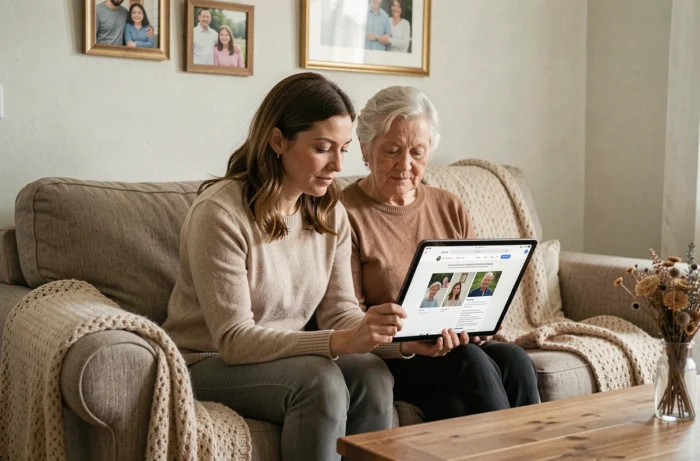
The systematic aggregation of notices poses a problem that few funeral platforms address head-on. A death notice contains personal data: names of relatives, family ties, sometimes ceremony addresses. This information remains accessible online well beyond the mourning period.
The privacy policy of Libra Memoria mentions the management of data by the Mempria Customer Relations service. Families can request the deletion or modification of a notice, but the procedure is not automated. They must contact the service directly, identify the relevant profile, and submit the request in writing.
We observe that this process remains unknown to most bereaved families, who sometimes discover months later that the notice remains online and appears in Google search results associated with the name of the deceased or their relatives.
Publishing a death notice via Libra Memoria: what the platform manages and what it delegates
Libra Memoria offers an online publication form structured in steps: choice of notice type (death, thank you, memory), selection of press title, entry of the deceased’s information, writing, and preview. The actual publication goes through the selected newspaper, not directly through Libra Memoria. The platform serves as an input interface, but the publication depends on the editorial calendar of the press title.
The publication fee varies according to the chosen newspaper, the size of the announcement, and the selected graphic options. Libra Memoria does not publish a unified pricing grid: each title applies its own conditions. Families comparing prices between two partner newspapers will notice sometimes significant discrepancies for identical content.
The distinction between the notice published in the newspaper (paid, with print and digital distribution) and the online profile on Libra Memoria (automatically generated from this publication) remains unclear in the interface. A paid notice for Le Bien Public will also appear on Libra Memoria, but the reverse does not exist: submitting an online tribute does not generate any press publication.