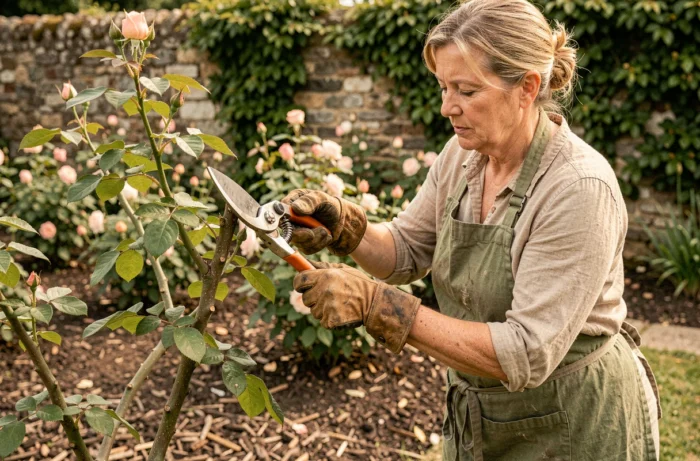
Have you ever noticed that a rose bush pruned too high produces long, bare stems, with a few flowers lost at the very top? The cutting height directly determines the number and quality of the roses. Pruning a rose bush is not just about shortening what seems excessive; it is a technical gesture that directs the sap towards the most productive buds. Understanding where to cut, and especially at what height, radically changes the outcome in the garden.
Pruning Intensity According to the Vigor of the Rose Bush: The Principle That Guides Often Overlook
Most articles suggest a single cutting height for all bush roses. In practice, professionals think differently: they adapt the height to the vigor level of each plant.
A very vigorous rose bush, one that produces thick shoots every year, can be pruned low. By cutting it short, we multiply the emergence of new stems, and each stem produces a flower bud. The result: more roses, better distributed on the plant.
A weakened rose bush (sparse foliage, thin stems, slow growth) needs to retain more wood. Pruning it too short exhausts it. Weak rose bush: keep more height to preserve its reserves. It will regenerate better and bloom more regularly, even during dry springs.
Specifically, to know at what height to prune roses, you must first assess their general condition. This reading of the plant before each cut makes all the difference between mechanical pruning and thoughtful pruning.
Cutting Height for Bush Roses: Practical Guidelines in Centimeters
For bush roses, the reference range is between 20 and 30 cm above the ground. This margin is not trivial. It corresponds to a precise physiological logic.
Why Aim for 20 to 30 cm Above the Ground
By maintaining this height, we preserve enough potential leaf surface for rapid recovery. The buds in this area benefit from a good supply of sap. Pruning at 20-30 cm from the ground promotes rapid recovery and dense blooming.
Cutting below 15 cm weakens the plant, especially in poorly draining soil. Staying above 40 cm produces long stems with flowers only at the top, which leaves the base of the rose bush bare.
Cutting at the Right Spot on the Stem
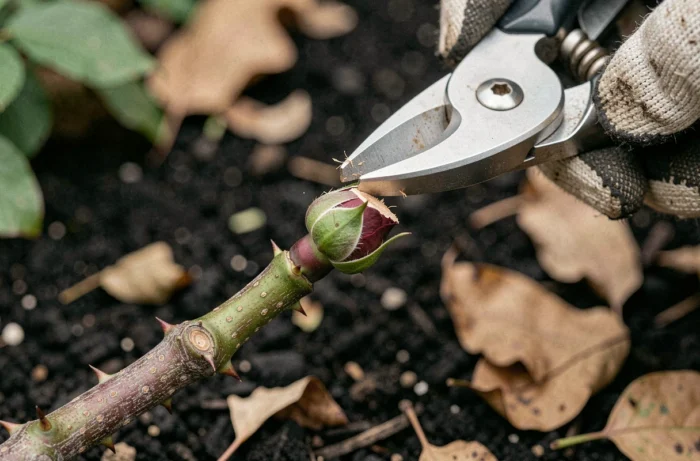
Height alone is not enough. The precise location where you cut matters just as much. The marker to look for is a bud oriented outward from the rose bush (called an “eye”). Cut about half a centimeter above this eye, at an angle.
- If you cut too far above the bud, the remaining stem tip (the stub) dries out and can promote diseases.
- If you cut too close, you risk damaging the bud itself.
- If the bud is turned inward, the new shoot will clutter the center of the rose bush and reduce air circulation.
The cutting signal is the position of the bud, not the wilted flower. Always look for a five-leaflet leaf oriented outward: the bud at its axil is your ideal cutting point.
Climbing and Shrub Roses: The Arc Technique to Bloom Without Cutting Back
Do you have a remontant climbing rose that only blooms at the top? This problem arises from the verticality of the stems. When a stem grows straight, the sap rises to the top, and only the last buds bloom.
Arching the stems horizontally triggers blooming along their entire length. This action, called arching, involves gently bending the long shoots of the year and attaching them to supports (trellis, taut wire, fence). The sap then distributes more evenly, and each bud along the stem can produce a flowering branch.
Arching is done in summer on the soft shoots of the year. According to field reports from gardeners, this technique produces a multiplication of flower buds that extends until frost. For untrained shrub roses, the same principle naturally applies when the branches droop under the weight of the flowers.
Maintenance Pruning on Climbing Roses
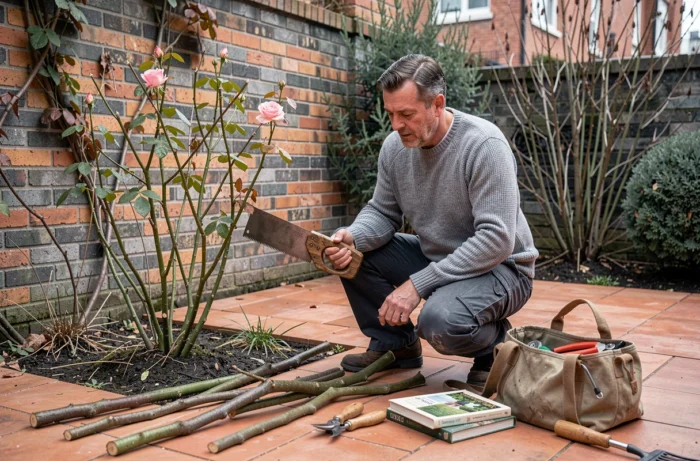
Unlike bush roses, a climbing rose is not cut back to 20 cm. The pruning involves shortening the lateral branches (those that come from the main stems) to two or three buds. The main canes, these long stems that form the framework, are only cut when they are too old or unproductive.
On a climbing rose, we prune the lateral branches, not the main canes. This is the most common mistake: cutting the large stems thinking to “clean” the rose bush, while they are the very structure of future blooming.
Summer Pruning of Remontant Roses: Remove Wilted Flowers at the Right Level
Remontant roses bloom several times during the season, provided that wilted flowers are removed correctly. Cutting just below the flower is not enough: the new shoot will be too weak to bear a beautiful rose.
The correct action is to go down to the first five-leaflet leaf turned outward. This is generally a few centimeters lower than the flower. Going down to the five-leaflet leaf ensures a stem strong enough to bloom again.
- On a remontant bush rose, this summer pruning is repeated after each wave of blooming, from June to September.
- On a remontant climbing rose, we simply remove the wilted bouquet by cutting just above the first complete leaf.
- On a non-remontant rose (one bloom per year), we do not prune in summer: pruning is done after flowering, by cutting the branches that have bloomed.
Summer pruning is not structural pruning. It aims solely to redirect the energy of the rose bush towards the production of new buds rather than towards fruit formation (hips).
A rose bush that leaves wilted flowers in place slows its growth to produce seeds. By removing them at the right level, you signal it to start blooming again. This simple action, repeated regularly between spring and autumn, makes the difference between a rose bush that produces two waves of flowers and one that blooms continuously all summer long.