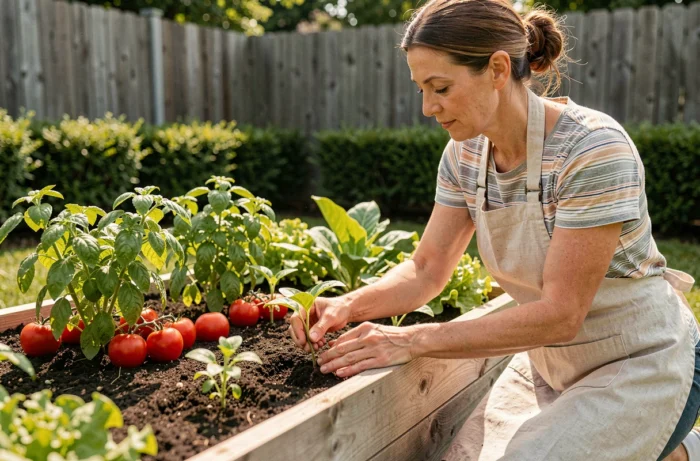
Growing an organic vegetable garden at home requires navigating an evolving French regulatory framework and climatic constraints that alter gardening practices. Before planning your first crops, a few realities need to be established.
Prefectural Orders and Water Restrictions: What Organic Gardens Risk
Watering the vegetable garden in France is subject to prefectural orders of restriction, organized into four levels: vigilance, alert, heightened alert, and crisis. When the crisis level is triggered, watering the garden may be completely prohibited, even by hand.
Violating these restrictions constitutes a 5th class offense. The fine can reach 1,500 euros, increased to 3,000 euros in case of repeat offenses.
These orders differ from one department to another and evolve throughout the season. Consulting prefectural publications before each watering becomes a necessary reflex, not just a simple recommendation.
For an organic vegetable garden, this reality weighs heavily from the design of the planting beds. Thick mulching, choosing drought-tolerant varieties, and improving soil retention capacity are no longer matters of perfectionism: they are conditions for success in the face of increasingly uncertain water access. To delve deeper into these methods, the Jardinage Bio website details several concrete approaches suitable for family gardens.

Rainwater Harvesting and Non-Potable Water: New Framework Since 2024
A decree from July 2024 established a national experimental framework for the reuse of non-potable water. Watering vegetable gardens is among the explicitly authorized uses. Rainwater, well water, gray water: the scope is broad.
There are obligations accompanying this opening. Any rainwater harvesting system connected to the building’s internal network requires a declaration at the town hall. Domestic wells and boreholes used for the garden are subject to the same formalities.
Domestic Wells: Declaration and Control
Watering your organic vegetable garden from a well seems logical. The quality of the water obtained varies greatly from one site to another, depending on local geology. Nitrate or heavy metal levels can compromise the soil you are trying to protect.
An undeclared well exposes you to penalties. The declaration is made at the town hall.
Before undertaking drilling work, checking the quality of the local groundwater helps avoid unnecessary investment. The BRGM and basin water agencies publish accessible data on this point.
Living Soil and Organic Gardens: What Compost Alone Does Not Cover
Compost plays a central role in most organic fertilization guides. It improves soil structure and provides nutrients. However, on its own, it does not guarantee soil capable of retaining water and supporting demanding crops over several seasons.
The ability of soil to function relies on the diversity of its microbial fauna and flora. Mycorrhizal fungi, nitrogen-fixing bacteria, earthworms: each plays a role in soil structure and nutrient circulation. Tilling the soil with a rototiller every spring compromises this underground life.
Permanent Soil Cover Techniques
Mulching limits evaporation, but its role goes beyond that. A permanent organic cover (hay, straw, dead leaves, wood chips) continuously nourishes the soil fauna. The principle is documented: a covered soil loses significantly less water than bare soil. Available data do not allow for precise quantification of water savings according to the types of mulch.
- Untreated meadow hay, cut before seed set, provides a nitrogen-rich mulch that decomposes in a few months and feeds the soil.
- Wood chips (BRF) are more suitable for paths and perennial crops, as their slow decomposition can mobilize soil nitrogen to the detriment of annual vegetables.
- Dead leaves, collected for free in autumn, form a light mulch suitable for spring sowing, provided they are stored dry during winter.
Mulching a soil that is already compacted and saturated with water in winter can, on the other hand, promote slugs and fungal diseases. Mulching should be considered based on the season, soil type, and local climate.
Crop Associations and Rotation: Solid Data and Areas of Uncertainty
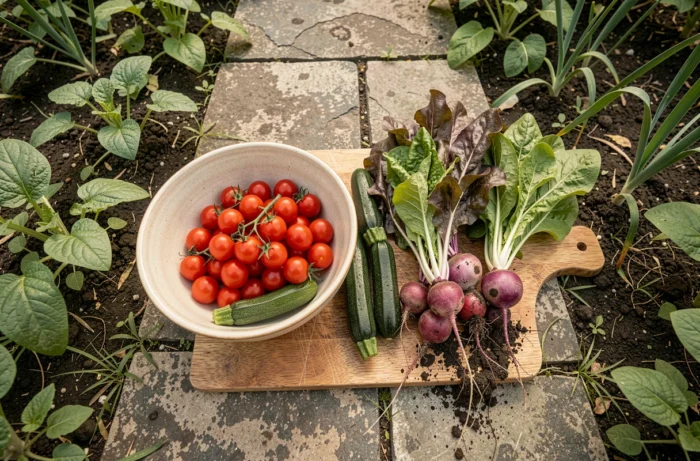
Tables of plant associations are ubiquitous. Their scientific foundation remains uneven. Some interactions are well documented: legumes (beans, peas) fix atmospheric nitrogen and benefit neighboring or subsequent crops. The proximity between carrots and leeks disrupts certain pests due to the volatile compounds emitted by each species.
Other associations rely more on gardening tradition than on reproducible results. A beginner gardener would do well to focus on a few proven combinations rather than exhaustive grids whose reliability remains to be confirmed.
Rotation: Why Four Years Minimum
Crop rotation slows the accumulation of specific pathogens in the soil. Four years between two crops of the same botanical family in the same location is the recognized minimum. Solanaceae (tomatoes, peppers, eggplants) and cucurbits (zucchinis, squashes) are particularly exposed to soil-borne diseases when they return too quickly to the same spot.
- Year 1: fruiting vegetables (tomatoes, zucchinis) on a plot enriched with compost.
- Year 2: leafy vegetables (lettuces, spinach) that benefit from residual fertilization.
- Year 3: legumes (beans, peas) that recharge the soil with nitrogen.
- Year 4: root vegetables (carrots, radishes) that structure the soil deeply.
On a small area, this rotation requires planning. A planting plan drawn up each winter, even in a simple notebook, avoids placement errors that lead to diseases and disappointing yields.
The success of an organic vegetable garden depends less on the number of tips applied than on taking into account real constraints: regulatory framework on water, soil condition, rigor of rotation. The first seasons serve as much to observe your plot as to harvest.