
The online women’s fashion market is no longer just a showcase of seasonal novelties. With the rise of second-hand shopping, upcoming European regulatory obligations, and return rates that undermine the profitability of e-commerce retailers, the trends in women’s fashion to shop online are now viewed through a much broader lens than just a simple lookbook.
Online return rates and their impact on the choice of women’s fashion pieces
Product returns remain the Achilles’ heel of online clothing purchases. The most returned categories (fitted dresses, high-waisted pants, structured blazers) share a common point: they heavily depend on fit and drape on the silhouette.
We observe that purchases that generate the fewest returns involve loose-fitting pieces or basics where sizing varies little from brand to brand. Straight jeans or wide-leg jeans, for example, tolerate size discrepancies better than slim jeans. Fluid viscose dresses are more forgiving than a fitted technical knit dress.
Opting for loose cuts mechanically reduces the risk of returns, and this is a criterion that regular shoppers now incorporate into their selection. On the Lyly Store online shop, this type of versatile piece constitutes a significant part of the catalog, precisely because they adapt to various body shapes without unpleasant surprises upon receipt.
Another underestimated lever: enriched size guides. Platforms that offer detailed flat measurements (shoulder width, back length, hip circumference) display significantly lower return rates. Virtual fitting in 3D, offered by some players, remains marginal in terms of actual adoption.
Second-hand women’s fashion: a structuring purchasing channel
Second-hand is no longer a niche segment reserved for vintage addicts. According to the consumer barometer from the French Institute of Fashion published on September 4, 2026, second-hand accounted for 10.9% of clothing purchases in value in the first quarter of 2025, with significantly higher penetration among 18-34 year-olds.
This figure reflects a structural shift. Shoppers no longer visit Vinted or the second-hand sections of e-shops just to save money. They seek designer pieces at reduced prices, models from previous seasons that are unavailable new, or materials (virgin wool, silk, thick linen) whose quality exceeds what new collections offer at a comparable budget.
What second-hand changes in trends
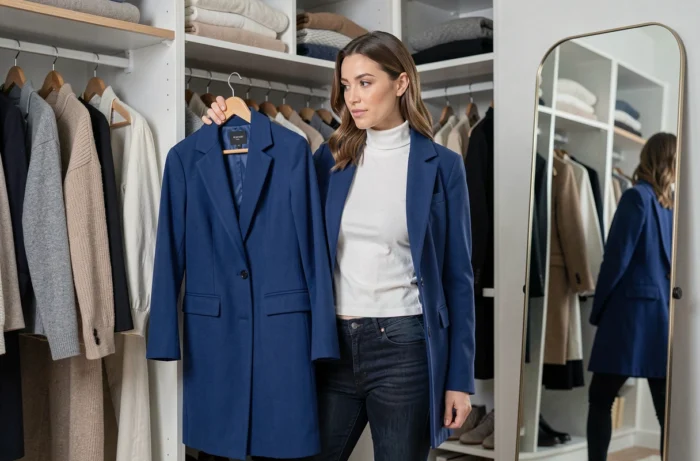
The direct consequence on women’s fashion trends is subtle but real. Long-lasting pieces gain desirability because they retain resale value. A classic trench coat, a wool blazer, a well-made crepe dress become investments, not just impulsive purchases.
Brands have understood this: several retailers now integrate a resale tab directly on their site. This is not philanthropy; it is a customer retention strategy.
European online fashion regulation: what is changing concretely
The European regulation on the eco-design of sustainable products will change how clothing is presented and sold online. Two axes directly concern shoppers.
- The ban on the destruction of unsold textiles is being phased in. Brands and platforms will no longer be able to eliminate dormant stock, which should mechanically increase clearance periods and end-of-line offers online.
- Platforms will need to verify certain compliance information from sellers. For shoppers, this means better traceability of products purchased on marketplaces, where the origin often remains opaque.
- A clearer environmental display will eventually accompany product sheets, allowing for comparison of the impact of two similar pieces before purchase.
In France, the law on fast fashion adds an additional layer. Ultra-fast fashion brands that renew their collections at an extreme pace face increasing constraints, which could redistribute some traffic towards e-shops with more measured turnover.

Women’s fashion trends for autumn-winter: the pieces to shop for priority
We recommend focusing the budget on four categories of pieces that combine stylistic relevance and a low risk of disappointment upon delivery.
Jeans remain the backbone of the wardrobe. The barrel cut (wide leg that narrows at the ankle) has dominated searches for several seasons, and its silhouette tolerates online shopping well. In raw or light-washed versions, it is a piece that resells easily in second-hand if it does not fit.
Thick knitwear replaces lightweight coats as the key piece for the cold season. Oversized cardigans, high-neck sweaters in blended wool: these pieces offer an excellent style-comfort ratio, and their generous sizing limits unpleasant surprises. The look is built through layering, allowing for ordering one’s usual size without hesitation.
In terms of dresses, the autumn-winter trend favors mid-length models in jersey or ribbed knit. These stretchy materials absorb variations in body shape, a decisive advantage for online shopping.
Accessories and shoes: the safe bets
Square-toed boots and structured medium-sized bags remain the most sought-after accessories. Their advantage for distance buying: accessory sizing rarely poses a problem, unlike clothing. These are low-friction purchases, ideal for a first order on a new site.
The fashionable style of the season is built around durable, resalable pieces that are compatible with online shopping. Women’s fashion trends are no longer disconnected from the logistical and regulatory realities that now frame textile e-commerce. Smart online shopping also means integrating these parameters into every purchasing decision.