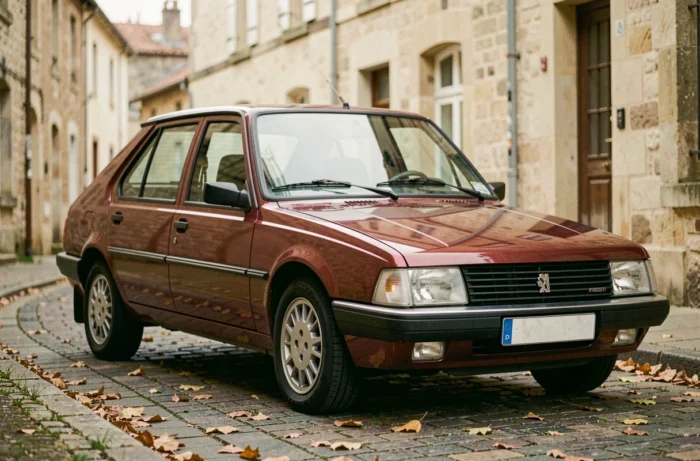
The Peugeot 305 GTI 16 has never appeared in any official Peugeot catalog. This name has circulated for decades among enthusiasts, blending the actual sporty versions of the 305 (GT, GTX) with artisanal preparations incorporating 16-valve engines from other PSA group models. Understanding this phenomenon requires looking back at what the 305 actually offered and what enthusiasts have done with it since.
The XU Engine and the Technique Behind the Sporty 305s
The Peugeot 305 was produced between 1977 and 1988. The most performance-oriented versions of the range, labeled GT and GTX, relied on the XU engine family, an aluminum architecture shared with other PSA models. These blocks, in an 8-valve configuration on the 305, provided a good power-to-weight ratio for the time.
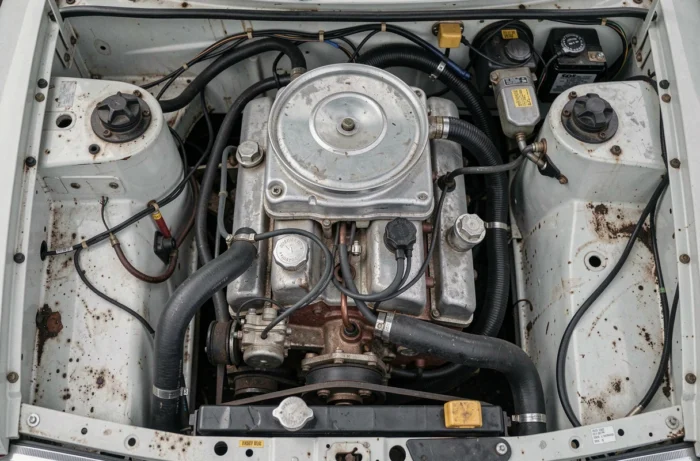
The suffix “GTI 16” found in enthusiasts’ discussions refers to a graft: that of a 16-valve cylinder head usually sourced from the 405 Mi16 or the 309 GTI 16. The XU block is suitable for this operation, as the engine base remains dimensionally compatible. The result is a lightweight sedan equipped with a much livelier engine than the original.
This practice of XU 16-valve engine swapping has fueled the legend of a “305 GTI 16” which, in fact, falls under amateur or semi-professional preparation. No Peugeot assembly line has produced this combination. To learn more about the Peugeot 305 GTI 16, one must turn to the community of preparers and specialized clubs rather than the manufacturer’s archives.
Collection Registration for the Peugeot 305: Rules and Practical Consequences
Any Peugeot 305 can now claim the status of a collectible vehicle. With production having ceased in 1988, each example far exceeds the 30-year threshold required by French regulations. Obtaining the collection registration requires that the vehicle be maintained in a condition consistent with its origin, without major modifications to the engine, chassis, or bodywork.
This point creates a direct tension with the preparations mentioned above. A 305 equipped with a non-original 16-valve engine cannot, in principle, obtain this “collection” designation without going through a specific homologation procedure. The FFVE (Fédération Française des Véhicules d’Époque) issues the necessary certificates, and its examination focuses precisely on compliance with the production model.
What the Collection Status Changes Practically
- The technical inspection occurs every five years instead of biannually, reducing administrative maintenance constraints.
- Traffic restrictions related to low emission zones (ZFE) and the Crit’Air system may be relaxed for vehicles with collection status.
- The resale of a collectible vehicle benefits from a distinct tax framework, with a flat tax on collectibles rather than the standard capital gains regime.
For an original 305 in good condition, the process is relatively simple. For a prepared “GTI 16,” the collection registration is inaccessible without returning to factory configuration.
Youngtimer Valuation of the Peugeot 305: A Market Without Fixed Benchmarks
The 305 does not appear in any structured valuation index like the 205 GTI or the 309 GTI 16. Transactions remain rare and scattered, making any value estimation very uncertain. Examples in concours condition trade at modest prices compared to other collectible Peugeots, but the trend is upward for well-preserved GT and GTX versions.
Several factors explain this discretion in the market:
The 305 was produced in very large numbers, especially in the base sedan version. The sporty versions, on the other hand, represent a marginal fraction of total production. Finding an unmodified GT or GTX is now a challenge, as many have been cannibalized for their mechanical parts, particularly the XU block coveted by preparers of 205 and 309.
The 305 station wagon, however, retains a small community of collectors attached to its understated design and versatility. A few examples still circulate in daily use in rural French areas, demonstrating the mechanical robustness of the platform.
Peugeot 305 GTI 16: Untangling the Myth from Technical Reality
The term “305 GTI 16” functions as a shortcut. It denotes an aspiration more than a model: that of a lightweight French sedan, simply designed, transformed into a discreet sports car thanks to a 16-valve engine. The principle is the same as that which has driven generations of mechanics to install Renault 5 Alpine engines in Renault 4Ls.
The difference with other automotive myths is that the technical base genuinely allows for it. The XU block is modular by design, and PSA adapted it across a dozen models between the 1980s and 2000s. Transitioning from an 8-valve to a 16-valve on a 305 requires real know-how, but no custom machining or modification of the engine cradle.
Specialized forums document these transformations with remarkable detail: references for wiring harnesses, choices of injection mapping, adaptation of the cooling system. This community documentation effectively constitutes the only “technical catalog” for the 305 GTI 16.
The Peugeot 305 remains a car that the general public has forgotten in favor of its younger sibling, the 205. Enthusiasts who maintain or prepare 305s do so without any expectation of heritage valuation. It is precisely this absence of speculation that preserves the authenticity of the phenomenon.