
Xamoz.com is a commercial site registered in April 2025 in the United States, with the domain name expiring in April 2026. Several reliability analysis platforms give it very low ratings, with no positive reviews emerging from the available evaluations. For French consumers tempted by its offers, the question of risks to their credit card and personal data is a direct concern.
Xamoz and the technical signals that alert before even making a purchase
The automated analysis criteria applied to Xamoz.com paint a concerning profile. According to FranceVerif, which evaluates online stores based on over 120 criteria, the site presents neither legal notices, nor VAT number, nor verifiable physical address. No payment method is listed by the tool, which is a rare anomaly for a site claiming to sell products.
The domain name was created on April 6, 2025, and expires on April 6, 2026. Such a short lifespan is typical of ephemeral sites set up to collect payments and then disappear before claims can be made. Hosting in the United States further complicates any legal action from France.
By cross-referencing reviews on xamoz published on various platforms, a common finding emerges: no documented positive purchase feedback has been identified to date. The complete absence of favorable testimonials, combined with the lack of legal notices, places this site in the category of shops with questionable reliability.
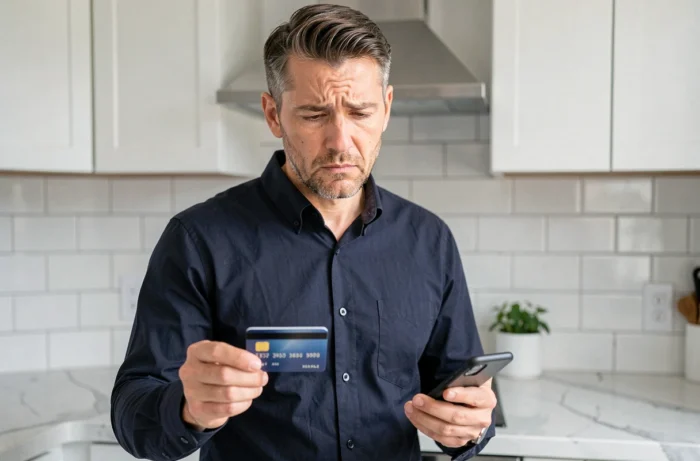
Credit card on Xamoz: the real danger is no longer number theft
Entering banking details on an unreliable site exposes one to an obvious risk of data capture. This classic scenario (retrieving the number, expiration date, and cryptogram) remains real, but it is no longer the dominant risk in 2025.
The Payment Security Observatory, linked to the Banque de France, published a note in January 2026 indicating that manipulation fraud accounts for about 40% of the total value of payment fraud in the first half of 2025, compared to 32% in the previous two years. This manipulation fraud refers to cases where the consumer themselves authenticates the fraudulent transaction, often after being redirected to a fake validation interface.
With a site like Xamoz, the most likely scenario combines both risks. The consumer enters their data on the site, then receives an SMS or notification inviting them to validate a payment via their bank’s strong authentication. By validating, they authorize a transaction they believe to be legitimate. Two-factor authentication does not protect if it is the buyer who confirms a fraudulent operation.
Personal data and resale on the dark web
Beyond the credit card, a site without legal notices or identifiable privacy policy offers no guarantee regarding the handling of collected data. Name, first name, postal address, email address, phone number: this information has market value on parallel markets.
France is facing a surge in data leaks. This stolen information then fuels targeted phishing campaigns, where the scammer uses the victim’s name and address to lend credibility to their message. A purchase on Xamoz could therefore have consequences far beyond the amount of the initial order.
Concrete reflexes in the face of a suspicious online store
Before entering any identifier or card number on an unknown site, several quick checks can help eliminate the riskiest platforms.
- Check for the existence of legal notices, a SIRET number or an intra-community VAT number, and a physical address. Their absence is a priority warning signal.
- Verify the age of the domain name: a site created less than a year ago, with a close expiration date, presents a high-risk profile.
- Run the URL through a reliability analysis tool (FranceVerif, ScamAdviser) before any purchase. A very low rating or the absence of verified reviews should halt the process.
- Prefer virtual single-use credit cards offered by most French banks. Even in the event of a leak, the number cannot be reused.
- Never validate a strong authentication (push notification, SMS code) if the amount or recipient does not exactly match the order placed.
These checks take a few minutes. They would have been sufficient to identify Xamoz.com as a problematic site before any data entry.
Recourse after a payment on a fraudulent site
If a payment has already been made, the speed of response determines the chances of recovering the funds. The first step is to contact the bank to block the card and report the transaction as potentially fraudulent.
European regulations, particularly the Payment Services Directive (PSD2), provides a right to reimbursement for unauthorized transactions. However, when the customer has themselves validated the transaction via strong authentication, the case becomes more complicated. Banks may argue that the transaction was duly authenticated.
In parallel, reporting on the Cybermalveillance.gouv.fr platform allows documenting the scam and feeding ongoing investigations. Immediately changing the passwords of accounts using the same email address as the one provided on the suspicious site limits the risk of cascading compromise.
The Xamoz case illustrates a recurring pattern: an ephemeral site, without verifiable legal anchoring, that relies on attractive prices to trigger impulsive purchases. Detection tools exist and work, provided they are used before clicking “pay”.